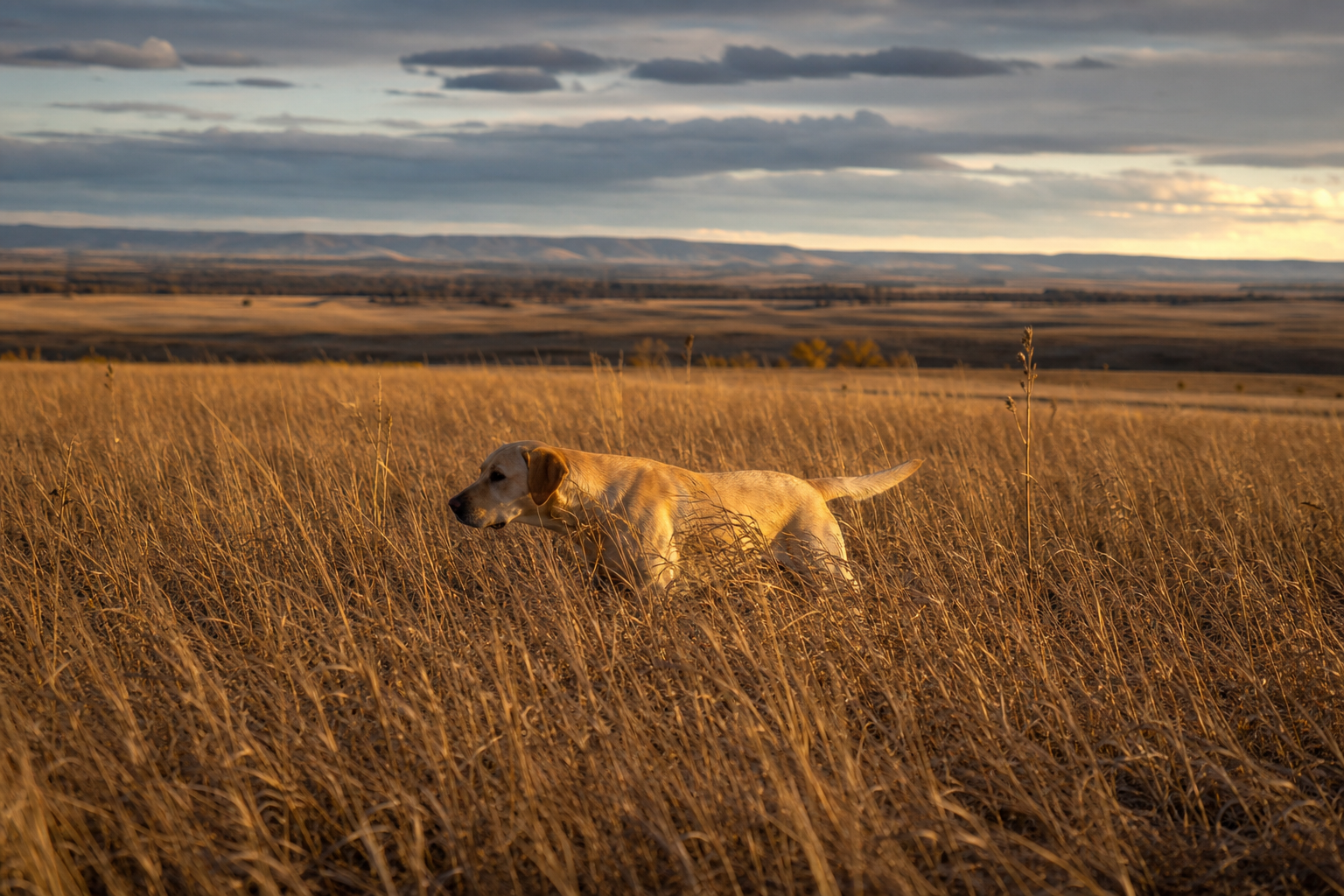
Wild Pheasant Scent Dynamics: Reading South Dakota Prairie Winds
A 30-mile-per-hour wind ripping off the Coteau des Prairies and across the James River lowlands doesn't just make your eyes water—it fundamentally dictates how scent travels, how dogs hunt, and how wild roosters plan their escape. Unlike pen-reared birds that sit passively regardless of air movement, a wild South Dakota rooster treats wind and air currents as primary survival tools from the moment he drops off his roost at sunrise. Understanding scent cones, atmospheric thermals, and wind-driven escape tactics is often the exact line between watching roosters flush out of range and walking into tight, crisp flushes over hard-working Labradors.
Here in Spink County, where vast prairie expanses meet agricultural edges and lowland river bottoms, wind is a constant partner in the field. To hunt wild pheasants consistently throughout the season, hunters and dog handlers must stop fighting the wind and start reading it like a map.
Why Prairie Wind Alters Scenting Conditions
To understand why your retriever works brilliantly on one field and struggles on the next, you have to look at how scent particles behave in open prairie air. Pheasant scent isn't a static trail laid out like a string on the ground; it is a dynamic, volatile plume of microscopic skin dander, respiratory vapor, and oils shed by the bird as it moves.
In calm, sheltered environments like eastern timber or heavy woods, bird scent settles in relatively stable, concentrated pockets. On the open South Dakota prairie, airflow changes the physics of scent propagation completely:
* Wind Shear and Scent Evaporation: High-velocity prairie winds rapidly dissipate scent particles, tearing the scent plume into fragmented micro-pockets rather than a clean, continuous cone. * Humidity and Scent Retention: Dry, windy days strip moisture from both the soil and the air. Scent molecules require humidity to bind to vegetation. When relative humidity drops below 40 percent under a stiff breeze, scent evaporates quickly, forcing dogs to rely on tight ground scent rather than rich air scent. * Ground-Level Boundary Layers: Wind speed isn't uniform from the sky to the soil. Friction against native switchgrass, big bluestem, and standing stubble creates a low-velocity air layer right at ground level. A rooster running under dense grass cover may leave a concentrated ground scent trail even while gale-force winds howl two feet above his back.
Recognizing these atmospheric variables helps handlers adjust their expectations and guide their dogs into positions where scent naturally accumulates.
Reading Ground Thermals and Morning Air Shifts
Wind direction measured at the local weather station gives you the big picture, but micro-climates and thermal air shifts dictate where scent actually settles on any given farm. Thermal currents—the vertical movement of air caused by surface heating and cooling—play a massive role in early morning and late afternoon wild pheasant behavior.
### Morning Down-Slope Air Flow During the cool hours around dawn, cold air is heavier than warm air. It naturally drains down off the higher benches of the Coteau des Prairies into the low-lying draws, cattail sloughs, and agricultural bottomlands near the James River. This subtle downward airflow carries scent with it, pooling scent particles in low swales and along heavy cover edges.
If you step out into a field at mid-morning just as the morning sun warms the dark prairie soil, that thermal pattern reverses. Warm air rises off exposed soil and cut agricultural fields, lifting scent upward and pulling fresh air out of adjacent cool grass strips. Experienced guides monitor these subtle shifts to decide whether to push a field along a ridge top or hunt the damp slough bottom where early morning scent remains trapped.
### Moisture Traps in Lowland Cover Heavy morning dew or rime frost acts as an extraordinary binder for wild rooster scent. As birds move out of their roosting cover toward feeding areas in agricultural crop edges, their bodies brush against wet grass stems, leaving heavy scent markers behind. Hunting these damp boundary lines early in the morning—before the wind dries the vegetation—offers some of the most dramatic scenting work a retriever will experience all season.
How Wild Roosters Use Wind to Evade Dogs and Hunters
A mature, wild South Dakota rooster has survived hawks, coyotes, severe plains winters, and weeks of hunting pressure. He understands how sound and scent travel far better than most humans do, and he actively manipulates air currents to stay alive.
### Running Crosswind to Break the Scent Trail When a wild rooster detects a hunting party approaching, his first instinct is rarely to take wing immediately. Instead, he puts his head down and sprints. A favorite trick of veteran roosters is running directly crosswind across the line of push. By moving perpendicular to the wind, the rooster drops his scent downwind of himself, leading dogs to trail air scent several yards away from his actual physical position. By the time the dog works out the scent puzzle, the rooster has put fifty yards between himself and the hunter.
### Using Sound Travel for Early Warning Sound travels exceptionally well downwind. If a hunting group pulls up to a field, slams truck doors, and talks loudly upwind of a piece of cover, wild birds several hundred yards downwind hear the disturbance clearly. They immediately begin running downwind or slipping out the side margins long before hunters step foot into the grass. Silent field entries and strategic vehicle parking downwind are critical tactics when pursuing wild birds.
### Launching into Headwinds vs. Tailwinds When forced to flush, a wild pheasant's choice of air direction directly affects shot difficulty:
* Headwind Launches: A bird flushing into a heavy headwind gains rapid vertical lift, rising almost straight up like a helicopter to gather altitude before banking. While this offers an initial close target, the bird quickly catches the wind shear and accelerates sideways at astonishing speeds. * Tailwind Escapes: A rooster flushing downwind launches low, catches the wind behind his wings, and can reach speeds exceeding 50 to 60 miles per hour in seconds. These birds offer rapidly lengthening target distances and require aggressive, decisive lead distance.
Tactical Line Setups: Aligning Your Push with Prairie Airflow
Executing a successful wild pheasant hunt requires aligning your walking line, your dog's quartering range, and your blocking positions relative to the prevailing wind.
``` PREVAILING WIND DIRECTION │ ▼ ┌──────────────────────────────────────────────────┐ │ [BLOCKER] [BLOCKER] │ <-- Downwind Escape End │ │ │ <=== Dog Sweep ===> <=== Dog Sweep ===> │ <-- Crosswind Pattern │ │ │ [HUNTER 1] [HUNTER 2] │ └──────────────────────────────────────────────────┘ ▲ │ Direction of Push ```
### The Crosswind Sweep: The Gold Standard for Retriever Work Walking directly into the wind (upwind) seems logical because it blows scent straight into the dog's nose. However, walking straight upwind often forces dogs to work too close to the line of hunters, as they catch scent only when they are directly downwind of a bird.
The most effective tactical setup for wild birds is the crosswind sweep. By pushing a strip of cover perpendicular to the wind, the wind blows bird scent across the path of the advancing line. As the dog quartering back and forth cuts through the wind line, it hits a wide plume of scent blowing sideways out of the cover. This allows the dog to lock onto scent from a distance and trail the bird cleanly into a solid, flushable position.
### Managing the Downwind Push Pushing a field downwind (with the wind at your back) is challenging because your sound and scent drift ahead of you into the cover. However, a downwind push can be extremely effective if executed with strategic blockers. As hunters move downwind, birds run ahead toward the end of the field. If silent blockers are anchored securely downwind at the field boundary, wild roosters find themselves pinched between advancing ground scent from behind and stationary visual barriers ahead, forcing them to flush within range of the blocking line.
### Pushing Cover Transitions Where two distinct cover types meet—such as native big bluestem abutting cut corn stubble—wind behavior changes instantly. The taller, denser grass creates a windbreak, slowing air movement near the edge. Wild roosters love to loaf in these softened micro-breezes along cover edges. Walking your dog just downwind of a heavy cover transition zone guarantees that any bird resting in the low-wind pocket will blow scent directly toward your retriever.
Working British Labradors in High-Wind Prairie Cover
At Coteau View Hunts, we raise and train British-line Labrador retrievers through Coteau View Kennels. Our philosophy has always been simple: *we don't breed for color, we breed for capability.* High-wind prairie environments put a dog's natural scenting mechanics, biddability, and mental stamina to an absolute test.
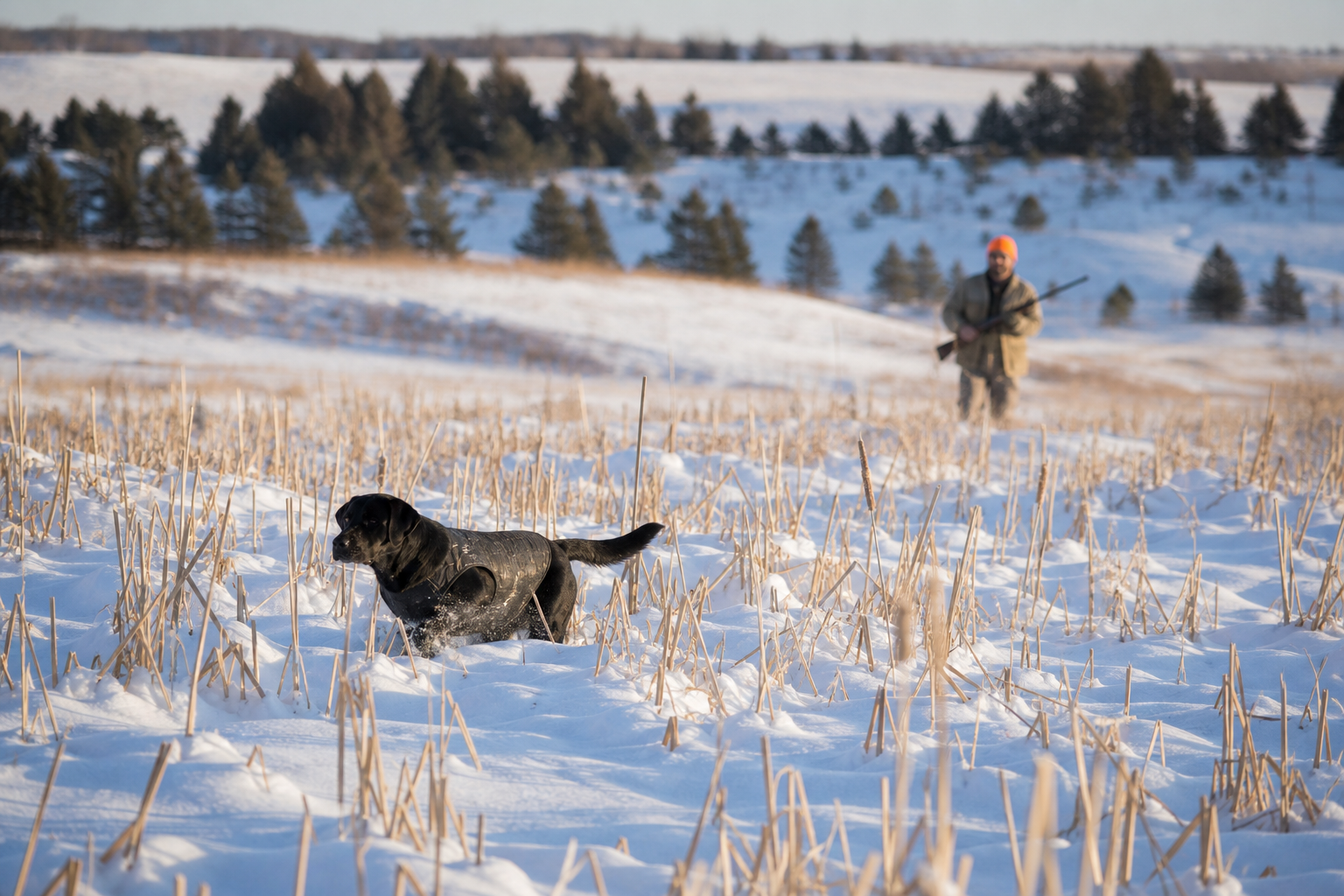
### Lower Head Carriage and Methodical Tracking British-line Labradors are renowned for their calm, game-finding composure and systematic tracking style. In high-wind conditions, an overly excited, high-headed dog often overruns scent plumes because high winds blow air scent clear over their heads. A dog that maintains a measured quartering pace and lowers its nose into the boundary layer of the grass picks up ground scent that erratic, high-ranging dogs miss entirely.
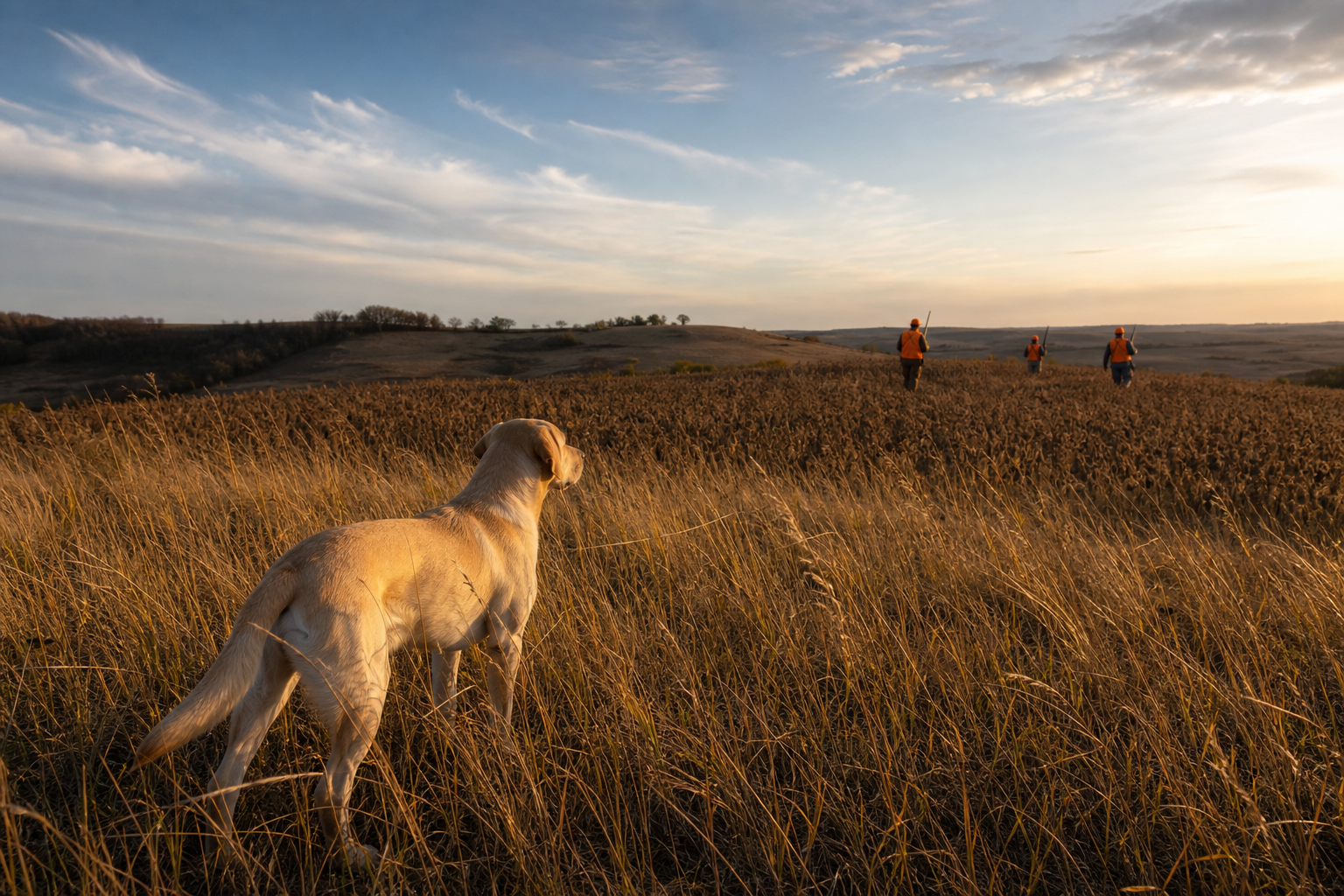
### Holding Close Line in Open Country When strong winds sweep across open terrain, a bird that flushes 40 yards away from a hunter is quickly blown out of safe range before a shot can be taken. British Labs are bred to work naturally within tight gun range (15 to 25 yards from the handler). Even when a bird runs hard downwind, a biddable Labrador stays tuned to whistle commands, allowing the handler to keep the dog constrained to effective shooting distance.
### Dog Hydration and Nose Care in Dry Winds A retriever's nose functions through a thin layer of moisture on the nasal membrane that traps odor particles. Stiff prairie winds act like a hair dryer, drying out a dog's nostrils and drastically reducing scenting efficiency. Guides take active steps to maintain peak dog performance during windy hunts:
* Frequent Water Breaks: Carry fresh water directly in the field, squirting water into the dog's mouth every 20 to 30 minutes, even in cold temperatures. * Lowland Resting Spells: Periodically route dogs through damp slough bottoms or around our 4-acre stocked pond between field pushes to let them cool down and rehydrate nasal tissues. * Eye and Nose Inspections: High winds blow dry seeds, chaff, and dust off cut crop fields. Checking a dog's eyes and snout after every push prevents irritation and scent fatigue.
Scenting Dynamics Across South Dakota Cover Types
No two fields handle scent in the same manner. Spink County features a diverse mix of lowland river terrain, native prairies, and rich agricultural ground. Understanding how wind interacts with specific vegetation types lets hunters adjust their approach field by field.
| Cover Type | Wind Behavior | Scenting Conditions | Primary Hunting Tactic | | :--- | :--- | :--- | :--- |: | Heavy Cattail Sloughs | Wind passes over top; calm air inside slough. | Scent pools near water line; heavy humidity preserves odor. | Push crosswind along outer edges; send dogs deep into thick core. | | Switchgrass & Bluestem | High wind friction; turbulent boundary layer. | Good ground scent; air scent broken into small pockets. | Work tight zig-zag patterns across the wind; keep hunters spaced close. | | Cut Corn Stubble | Minimal wind obstruction; rapid air movement. | Scent dissipates quickly; ground scent dries fast. | Target damp low spots, field corners, and grassy waterways within stubble. | | Tree Claims & Shelterbelts | Dramatic windbreak effect; eddying air currents on leeward side. | Scent swirls and eddies downwind of tree line. | Walk downwind edge of shelterbelt; position blockers at downwind tips. |
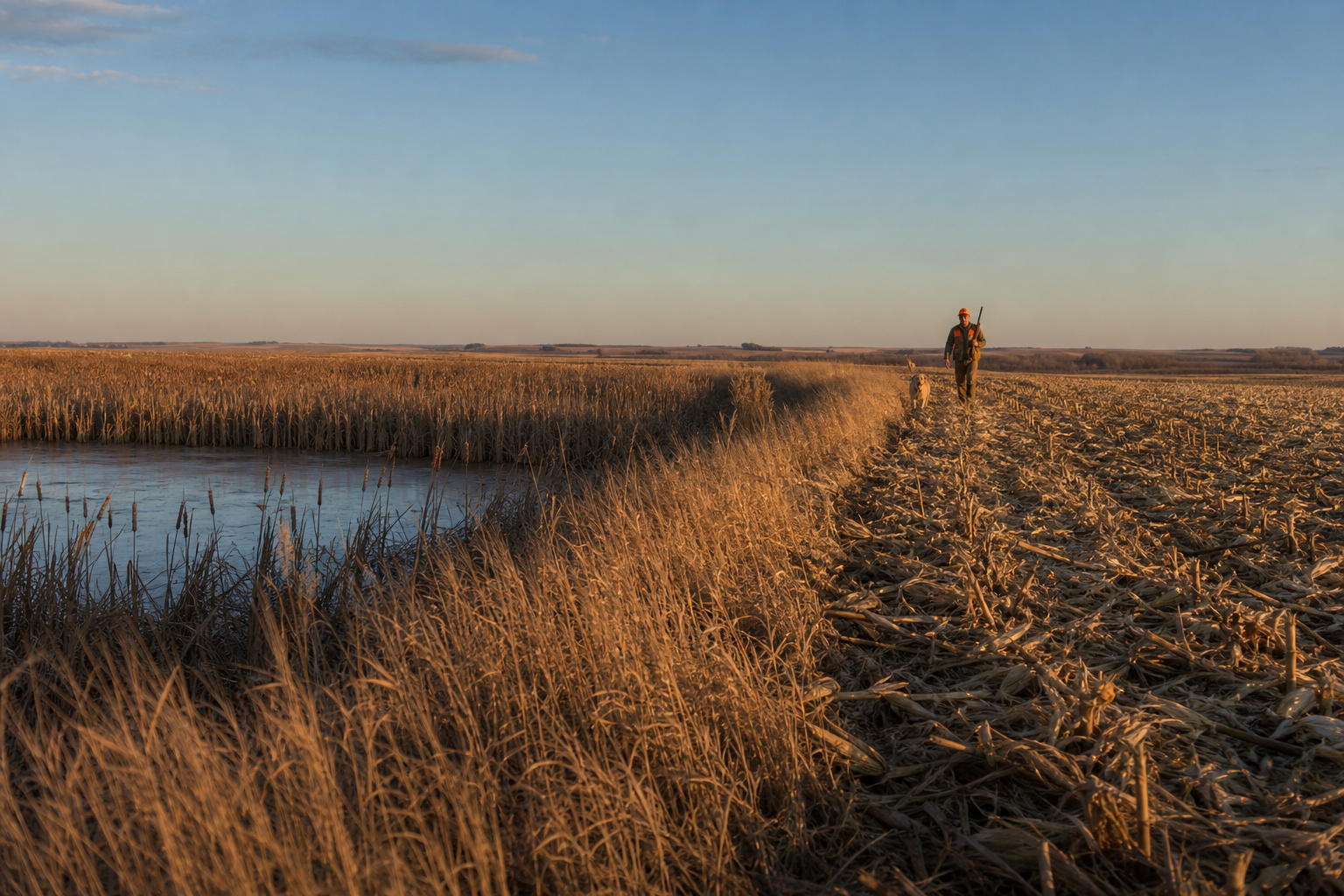
### Heavy Cattail Sloughs and River Bottoms Cattail sloughs in the James River basin act as massive thermal and wind shelters. While a 30-knot wind roars across the top of the cattails, down inside the stalks near the muddy ground, the air is almost completely still and saturated with moisture. Wild roosters flock to these sloughs during windy days to escape the bite of the wind.
Because air inside cattails is stagnant, scent doesn't drift far horizontally. Dogs must push physical body paths through the heavy cover to stumble into localized scent pockets. Walking hunters down the clean grassy margins while dogs hunt the interior cattail edge forces birds out of the quiet cover into open air where clean shots can be taken.
### Native Switchgrass and Warm-Season Prairie Dense switchgrass offers excellent bird holding cover, but its rigid stalks create micro-turbulences when high winds strike. Scent gets whipped into swirling patterns. In this cover, rushing through a walk is a mistake. Taking slow, deliberate steps and pausing frequently forces nervous roosters to break cover while giving your retriever time to unravel tangled scent trails.
### Cut Corn Stubble and Milo Fields After harvest, standing stubble offers little shelter from prairie gales. Wild pheasants feeding in stubble rely on keen eyesight and acute hearing. Scent in open stubble moves fast and leaves minimal trail. The key to hunting stubble in windy weather is focusing on low swales, grassy drainage ditch corridors, and field corners where blowing chaff and soil accumulate, creating small micro-break zones where birds find shelter.
Adjusting Shot Expectations and Ballistics in Prairie Gales
Wind doesn't stop affecting your hunt once the bird breaks cover. Executing clean, ethical kills on wild South Dakota roosters in heavy winds requires physical adjustments to your gun handling and lead calculation.
### Calculating Wind Drift on Shot Patterns Many hunters forget that wind acts on a shotgun's pellet stream just as it does on a rifle bullet. A 25-mph crosswind can drift a standard payload of #4 or #5 lead shot (or non-toxic equivalents) up to 10 to 15 inches sideways at 40 yards. If you shoot directly at a bird crossing downwind, your pattern will drift behind the bird's head into the tail feathers or miss entirely.
* Crosswind Leaded Shots: Lean hard into crosswind crossing shots. If a rooster is flying across your front from right to left with a left-to-right crosswind pushing your pattern, you must increase your forward lead to compensate for both bird speed and shot drift. * Tailwind Target Trajectories: A wild bird rising with a strong tailwind accelerates down-range instantly. Hunters frequently shoot high over tailwind roosters because the bird drops its profile as it flattens out into horizontal flight. Match the bird's line, swing through the beak, and slap the trigger as you clear the head. * Headwind Hovers: Roosters fighting a stiff headwind seem to hang stationary in mid-air. Don't be fooled by their slow forward progress; the wind is buffeting the bird violently. Resist the urge to snap-shoot; take a deliberate breath, build a solid cheek weld on the stock, and execute a controlled follow-through.
For updated guidelines on non-toxic shot requirements, seasonal possession limits, and state shooting hours, always consult the official [South Dakota Game, Fish & Parks](https://gfp.sd.gov/) regulations before heading into the field.
Real-World Spink County Field Scenarios
To see how scent dynamics and wind reading come together on an actual hunt, consider two common real-world scenarios we encounter during the season near Conde.
### Scenario A: The 25-MPH October Crosswind over Milo Strips It is mid-October, mid-afternoon, with a stiff 25-mph wind blowing out of the northwest straight across a 40-acre strip of grain sorghum (milo) bordered by native grass.
* The Setup: Rather than pushing straight down the length of the milo strip into the wind, the guide sets up a crosswind sweep. Hunters line up along the southern edge, walking eastward so the northwest wind blows across their left shoulders. * The Execution: Dogs are sent into the milo upwind of the walking line. As the dogs quarter across the rows, the wind carries scent blowing south out of the milo straight into their paths. Blockers sit silently at the far eastern corner of the crop strip. * The Result: Roosters running through the crop rows drop heavy scent downwind. The Labradors catch the scent plumes 15 yards before reaching the birds, locking into tight trailing points and producing crisp, close-range flushes right along the walking line.
### Scenario B: The Freezing November Down-Valley Thermal Shift In mid-November, a cold front drops temperatures into the 20s. A light early-morning breeze drains down off the Coteau des Prairies into the low-lying James River draw bottoms.
* The Setup: The guide holds off on hunting the wind-exposed high ridges early in the morning. Instead, the hunting group targets dense cattail swales where cold, damp air has settled over night. * The Execution: With ground moisture high, the British Labradors work close in the damp cover. The handler moves slowly along the edge, letting the thermal air flow down the draw into the dog's scenting zone. * The Result: Birds holding tight in the warm, quiet floor of the draw are pin-pointed by the dogs before they even think about running, yielding classic, heavy-rooster double flushes over frozen slough margins.
The Advantage of Hunting Wild Birds with Local Expertise
Preserve birds raised in pens simply do not exhibit the complex scenting and escape behaviors of wild, native ringnecks. Hunting true wild pheasants on open prairie terrain demands respect for the bird's natural instincts and a thorough reading of the landscape.
At Coteau View Hunts, our family has spent generations studying how wild birds react to changing prairie weather, season shifts, and ground conditions. We manage prime private acreage engineered specifically for wild bird habitat—rich food plots, heavy winter roosting cover, nesting grass, and natural lowland shelterbelts. Combined with our carefully bred British Labradors from Coteau View Kennels, our guided hunts offer an authentic upland experience rooted in deep field tradition.
When the wind begins to blow off the Coteau des Prairies, you don't have to head indoors. You just need to know how to turn the wind to your advantage.
Book Your Wild Pheasant Hunt at Coteau View Hunts
Ready to experience authentic South Dakota pheasant hunting for 100% wild roosters? Join us at Coteau View Hunts near Conde, South Dakota. Enjoy fully guided day hunts across managed prairie habitat, work behind top-tier British Labradors, and relax every evening in our private, comfortable lodge with home-cooked meals and modern amenities.
Whether you are planning a corporate trip or an annual hunt with close friends, our team is ready to deliver a classic South Dakota wild bird hunt.
* Phone: 605.395.7788 * Email: info@coteauviewhunts.com * Location: Conde, Spink County, South Dakota
Contact us today to check available dates and start planning your wild pheasant hunting adventure.
Ready to hunt this country?
We guide wild-bird pheasant hunts on private South Dakota ground. Check open dates or call the lodge at 605.395.7788.