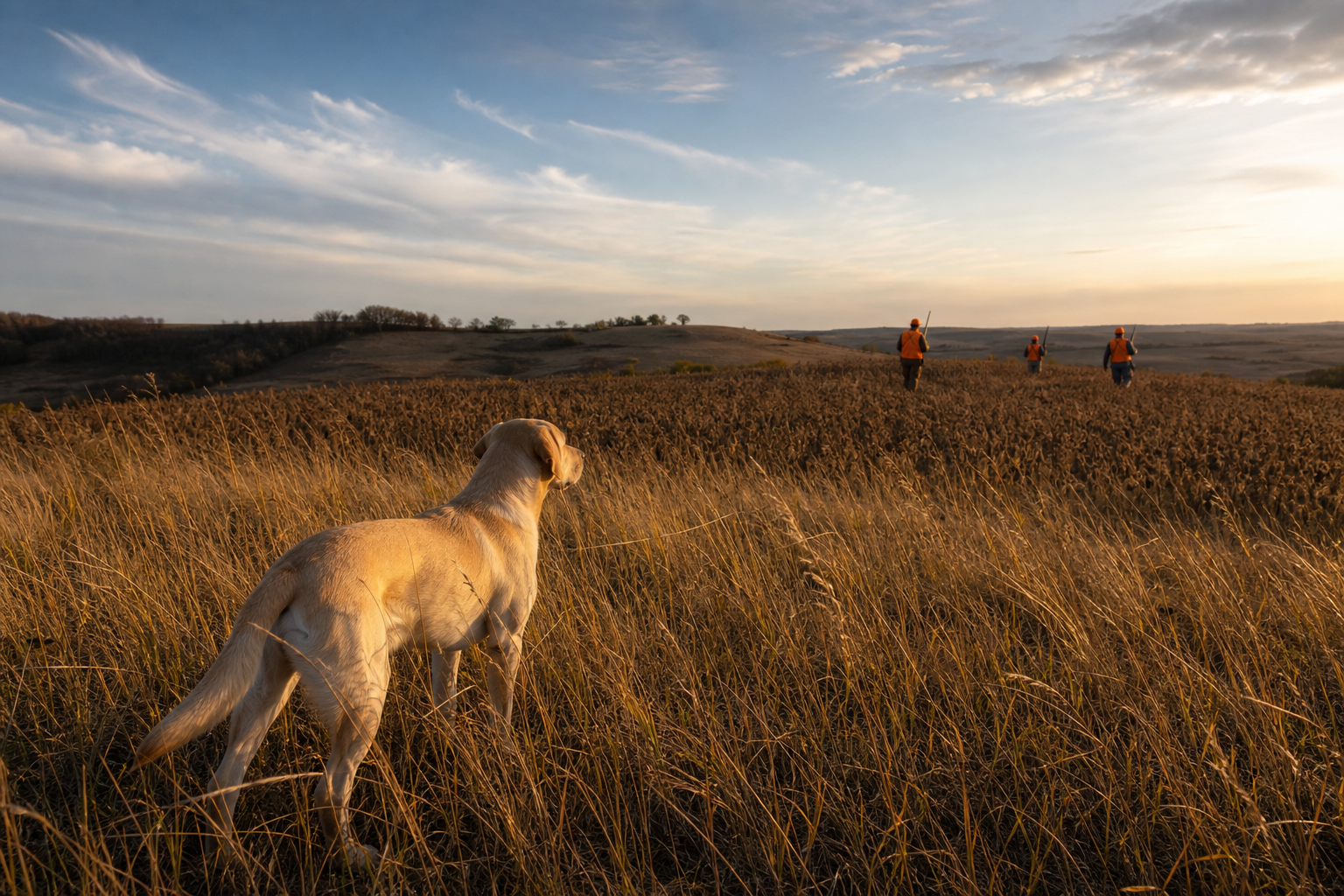
Pheasant Driving Tactics: How to Push, Block, and Pinch Wild Birds
A wild South Dakota rooster pheasant does not survive to see his second winter by making careless mistakes. He earns his long spurs and brilliant plumage by outrunning hunters on foot, slipping through fence lines unobserved, and exploiting every seam in an unstructured line of approach. Across the expansive James River lowlands and the rolling draws below the Coteau des Prairies, relying on casual walking or random wandering usually leaves hunters staring at empty sky while wild roosters flush hundreds of yards out of shotgun range.
Executing a disciplined, tactical drive—combining stealthy blockers, a tight pushing line, and strategic flankers—is the single most effective method for harvesting wary prairie roosters. When properly executed, a drive collapses a pheasant's escape routes, forcing birds into a structural pinch point where they must either hold tight for working retrievers or take flight within gun range. Understanding the mechanics of driving, blocking, and pinching pheasants turns vast prairie landscapes into controlled, high-probability upland hunts.
The Psychology of a Wild South Dakota Pheasant Under Pressure
To drive wild pheasants effectively, you must first understand how a rooster evaluates threat and navigates cover. Unlike pen-raised birds or younger, naive early-season birds, late-October and November wild roosters in Spink County are master escape artists. Their primary defense mechanism is ground speed, not flight. A mature rooster can run at speeds exceeding 8 to 10 miles per hour through dense cover—fast enough to easily outpace a hunter walking at a steady clip.
When a wild pheasant senses human presence, its initial reaction is to run directly away from the sound while staying under the protective canopy of grass, crop stubble, or cattails. As long as the bird has thick, unbroken cover ahead of it, it will continue running. It only takes to the wing when one of three things happens:
* It runs out of cover: The vegetation thins out into short pasture, bare dirt, a mowed road ditch, or open water. * It encounters a hard barrier: It comes face-to-face with stationary blockers positioned quietly at the end of the field. * It is intensely pressured by a dog: A close-working retriever cuts off its ground route, forcing an immediate vertical flush.
If roosters detect a gap in your line or notice that your blockers are out of position, they will immediately double back between pushers or slip sideways out of the cover. Field setup is not simply about walking across a patch of grass; it is about managing the bird’s escape instincts and controlling every vector of movement.
The Core Roles: Pushers, Blockers, and Flankers
A successful upland drive functions like a net drawing shut around elusive game. Every member of the hunting party has a designated responsibility, and a breakdown in any single role compromises the entire drive.
### The Pushers: Pace, Spacing, and Disciplined Deliberation
The pushers are responsible for moving through the heavy cover, stirring up birds, and herding them downfield toward the blocking line. The most common error pushers make is walking too fast. Fast walking creates a steady, predictable rhythm that allows pheasants to easily stay 50 yards ahead of the line without feeling panicked. When birds aren't panicked, they have the presence of mind to look for exit gaps.
Pushers should maintain an even, synchronized line spaced anywhere from 15 to 25 yards apart, depending on cover density. In standing sorghum or dense switchgrass, closer spacing is necessary to prevent birds from hiding or running between hunters. Pushers must periodically stop in place for 5 to 10 seconds. This sudden silence unsettles holding roosters; believing they have been spotted, birds that froze in place will often flush right at your boots.
### The Blockers: Stealth, Positioning, and Discipline
Blockers serve as the solid wall at the far end of the drive. The blocker’s job is not to chase birds, but to prevent roosters from running out of the cover unshot and to force birds coming down the pipeline into taking flight over the field.
Stealth is non-negotiable for blockers. If roosters hear truck doors slamming, loud talking, or heavy footsteps at the end of a cover strip before the drive begins, they will flush out the sides or double back before the pushers even start. Blockers must circle far around the field, slip into position quietly without being seen, and remain absolutely still and silent until the pushers close within range.
Blockers should position themselves inside the edge of the cover or just past the terminus of the strip, utilizing natural terrain features like trees, fence lines, or low terrain to break up their silhouette. Standing out in the open on a bare road or field edge will cause educated roosters to flush 80 yards out.
### The Flankers (Wingmen): Sealing Lateral Escape Routes
Flankers walk along the outer left and right edges of the push line, slightly ahead of the main body of pushers. Their primary function is to prevent pheasants from leaking out sideways into harvested crop fields, adjacent pastures, or bare dirt ditches.
As the push progresses, flankers pinch inward, forming a horseshoe pattern with the central pushers. This inward curve pushes birds away from the boundaries and keeps them moving toward the stationary blockers ahead.
Field Geometry: Tactical Setups for Prairie Cover
Different cover types across South Dakota require distinct driving strategies. A plan that works in a linear shelterbelt will fail in an open food plot or a sprawling wetland basin.
### Standing Crops and Sorghum Food Plots
Large rectangular food plots or standing crop fields present a geometry challenge because birds have plenty of lateral space to maneuver. To hunt these effectively:
- Divide the field into strips: Rather than pushing an entire 80-acre block at once, break it down into manageable sweeps using mowed trails or structural features.
- Establish a funnel: Position blockers where the food plot tapers into a grass waterway or corner edge.
- Use a zig-zag sweep: Pushers should walk a broad grid pattern to sweep birds from the outer boundaries toward the center channel, driving them straight into the waiting blocking line.
### Linear Shelterbelts and Tree Rows
Shelterbelts and multi-row windbreaks are natural high-density corridors for roosting and thermal cover, especially as winter approaches. Because these strips are long and narrow, they are ideal for small to medium-sized groups.
* Placement: Position two blockers at the far tip of the tree row, standing roughly 20 yards outside the heavy timber to maintain clear overhead shooting lanes. * Side Coverage: Place a flanker on each side of the shelterbelt, walking 10 to 15 yards ahead of the internal tree line. Roosters love to burst sideways out of tree rows when they hear dogs inside; flankers catch these side-slipping birds immediately. * Internal Pushers: Pushers inside the shelterbelt must move slowly, using close-working dogs to check brush piles, downed timber, and thick plum thickets.
### Heavy Cattail Sloughs and Wetland Basins
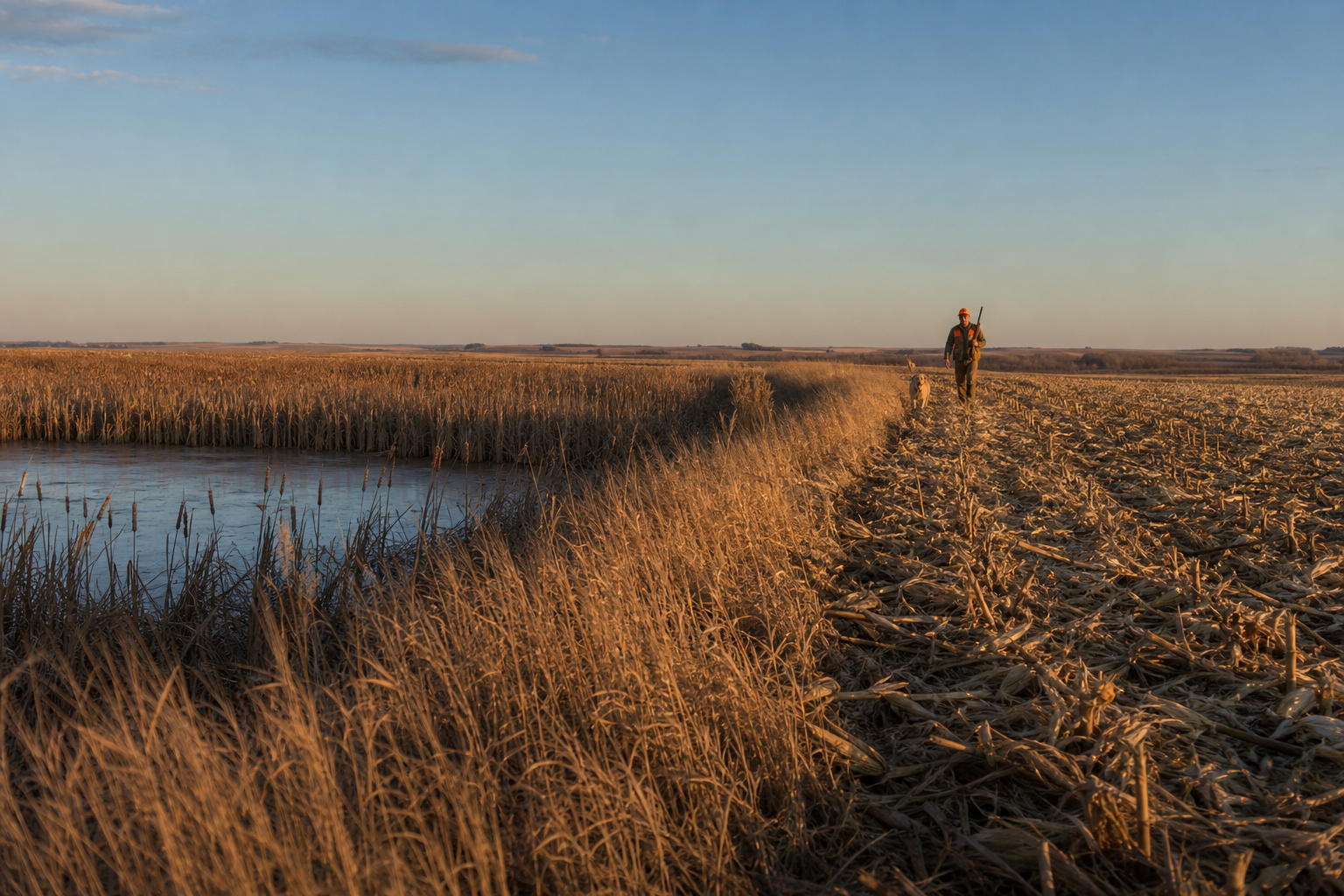
In the lowlands surrounding the James River, dense cattail sloughs offer security cover that roosters refuse to leave voluntarily. Running birds will duck through matrixes of dry stems, completely hidden from sight.
To drive a cattail slough:
* Identify the narrowing neck: Sloughs rarely form perfect circles; look for a narrow pinch point, a peninsula of vegetation, or an area where cattails transition into reed canary grass. * Set blockers at the exit transition: Blockers should stand where the thickest vegetation thins out, giving them clear visibility as birds break overhead. * Drive with the structure: Pushers must stay in a tight, abreast line across the marsh floor, taking care to keep dogs within 15 yards so roosters aren't bypassed in the matted underfoot canopy.
Wind Dynamics and Scenting Conditions
Wind is a dominant feature of South Dakota pheasant hunting, and ignoring wind direction during a drive is one of the quickest ways to ruin an outing. Wind impacts bird behavior, sound propagation, and dog scenting capability.
| Wind Angle relative to Drive | Effect on Pheasant Instincts | Impact on Hunting Dogs | Tactical Adjustment | | :--- | :--- | :--- | :--- |$ | Headwind Push (Pushing into the wind) | Birds hear pushers less easily, but scent travels straight to dogs. Roosters may hold tighter or flush back overhead into the wind. | Ideal for dogs; wind carries scent directly into their noses as they advance forward. | Pushers move deliberately; blockers must be alert for birds rising high and riding the wind back over pushers. | | Tailwind Push (Pushing with the wind) | Birds easily hear pushers coming behind them and start running early. They flush readily when encountering blockers downwind. | Difficult for dogs; scent is blown ahead of the dog line, making it hard to pinpoint holding birds. | Slow the push down significantly. Blockers must be fully set early because birds will move downfield faster. | | Crosswind Push (Wind blowing across line) | Birds tend to drift toward the downwind edge of the field cover to keep scent options open. | Dogs work best sweeping laterally across the line to catch the drift of scent cones. | Strengthen the downwind flank with extra flankers; birds will routinely try to break out the downwind side. |
When possible, design your tactical drives to push *into* a light-to-moderate headwind. This maximizes your gun dogs' ability to detect roosters hiding in deep cover before the birds run out of the zone, while helping your line stay close to scent sources.
The Science of the Pinch Point: Forcing the Flush
Every high-yield drive culminates in a "pinch point." A pinch point is the physical location where cover ends or narrows so dramatically that a running rooster no longer feels safe on the ground. When a pheasant reaches this boundary and realizes that blockers are standing ahead, its ground-escape strategy collapses.
### Creating Artificial Pinch Points
If you are hunting a vast stretch of uninterrupted cover with no natural end, you can create an artificial pinch point using smart positioning:
- The Converging Horseshoe: As the push line reaches the final 75 yards, the flankers swing inward, forming a tight semicircle around the nose of the cover. This compresses the space available to the birds from three directions at once.
- The Cut-Off Line: Have a portion of the pushing line step out to the field edge early, creating a visual barrier that prevents roosters from running down a continuous ditch line.
- The Mowed Transition: Use mowed property lines, vehicle tracks, or natural clearings as boundaries. Wild pheasants despise crossing open, bare ground on foot during daylight hours. When forced to face a 10-yard wide mowed strip with blockers positioned nearby, they will almost always flush.
### Managing the Final 50 Yards
The last 50 yards of any drive are where the vast majority of birds are harvested—and where discipline often breaks down. As the pushers close in on the blockers, excitement builds, but safety and patience must remain paramount.
Pushers must maintain their spacing and avoid closing the distance so fast that birds jump all at once in an uncontrollable mass flush. Take two steps, stop, scan the cover, let the dogs work, and take two more steps. This methodical pressure causes individual roosters to lose their nerve one by one, producing manageable single and double flushes rather than a sixty-bird cloud that flies out out of range.
Stealth vs. Pressure: Managing Sound in the Field
Sound management is what separates experienced South Dakota outfitters from amateur groups. Wild birds read human noise like a map.
### When to be Absolutely Silent
* Transport and Drop-Off: Never slam vehicle doors, drop tailgate chains, or allow dogs to bark at the edge of a field prior to a drive. Park vehicles away from the entry zone if possible. * Blocker Deployment: Blockers should walk quietly along field margins to reach their posts. Never talk, blow whistles, or load shotguns loudly once in position. * Initial Entry: Entering the cover should be done without shouting instructions across the field. Establish your strategy before leaving the lodge or truck.
### When to Use Controlled Pressure
Once the drive is underway, complete silence inside the pushing line is actually counterproductive. If pushers are entirely quiet, birds will feel comfortable weaving around you without taking flight. Controlled, steady sound—such as the rhythmic rustle of brush chaps through corn, gentle vocal commands to dogs, or tapping a wooden walking stick against crop stalks—lets roosters know an advancing line is approaching, keeping them moving forward into the pinch point rather than letting them hide in place.
Integrating Gun Dogs into Group Drives
Gun dogs are the heart of South Dakota upland hunting, but in a large group drive, unmanaged or out-of-control dogs will disrupt the geometry of the hunt. Success requires seamless teamwork between handler, line, and dog.
### Flushing Dogs: The Ultimate Driving Partners
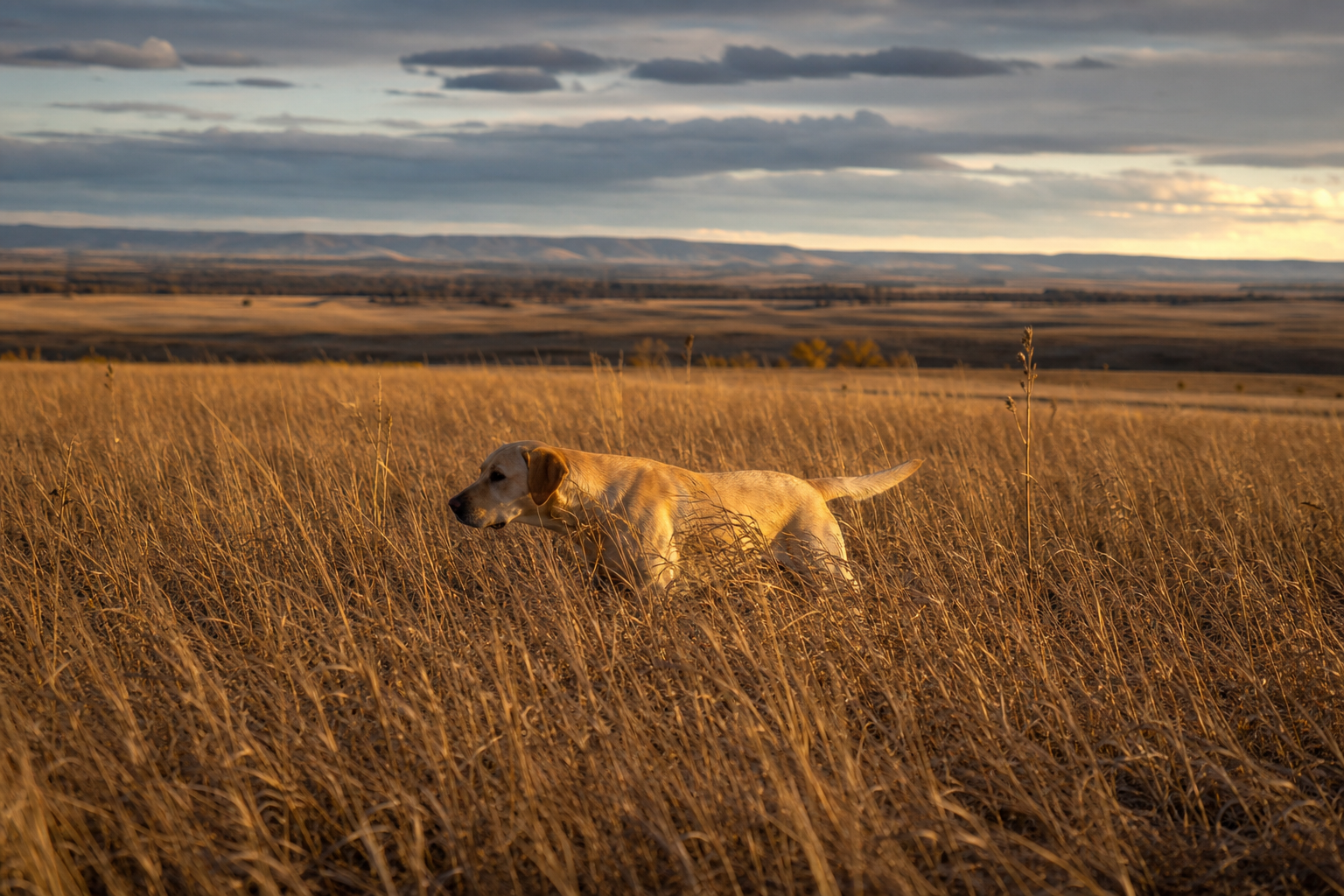
Close-working retrievers—such as field-bred British Labradors—are tailor-made for tactical group drives. Because they are bred for hunter-attuned temperament, heavy drive, and quartering within strict gun range, a well-trained British Lab operates as a precise tool within the line.
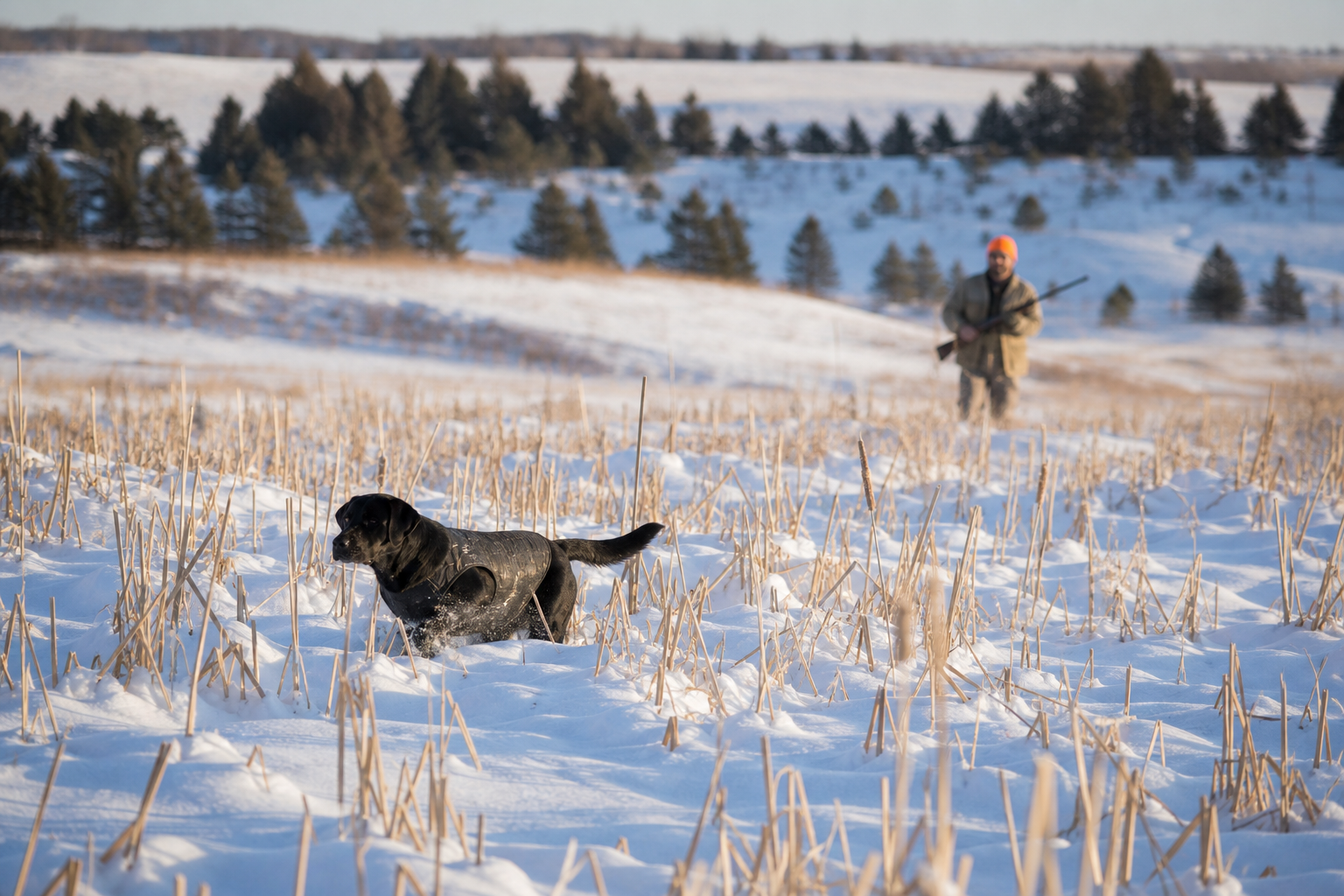
* Pattern Control: A flushing dog should quarter no more than 15 to 20 yards ahead of the pusher line. A dog that ranges 40 yards out will flush roosters well past the pushers and ahead of the blockers, offering no viable shot selection. * Rooting Out Bypassed Roosters: Mature roosters frequently crouch motionless in grass roots as pushers walk past. A dog with a keen nose will track down winded birds, forcing a flush directly over the push line. * Steadiness at the Pinch: When the drive reaches the pinch point and dozens of birds scent the air, a dog must remain under firm control, retrieving shot birds promptly without chasing running roosters into the blocker line.
### Managing Pointers in Group Drives
If pointing breeds are included in a group drive, handlers must keep them constrained to short quarters. A wide-ranging pointer that holds a bird 100 yards ahead inside heavy sorghum will cause the pushing line to break formation, creating gaps that other running roosters will instantly use to double back.
Five Common Tactical Errors That Ruin a Drive
Even experienced hunting parties fall into bad habits that allow prairie roosters to escape clean. Avoid these five critical tactical mistakes:
- Blockers Standing Too Far Out: Blockers who stand 50 yards into an open, harvested field give roosters plenty of time to see them, land short, or turn around. Stand right at the vegetation boundary or just inside it.
- The "Sagging Center": Pushers in the middle of the line often lag behind flankers or outer pushers, creating a pocket. Roosters running forward will sense this drop in pressure, turn around, and slip right through the center gap.
- Moving Too Fast Through Prime Cover: Rushing through thick cover allows holding birds to lie low and watch you walk right past them. Slow down and let the dogs work the thickest patches.
- Shooting Low Across the Line: As pushers close on blockers, safety is the primary concern. Never take low-angle shots at birds breaking flush at eye level toward other hunters. All shots taken near the pinch point must be sky-busted high overhead against clear blue sky.
- Abandoning the Drive Early: Stopping the drive 30 yards short of the field edge because "it looks empty" is a classic mistake. The smart roosters are sitting in that final 30 yards of cover. Always finish the push entirely to the boundary line.
Experience Master-Class Prairie Hunting at Coteau View Hunts
Executing perfect upland drives requires extensive terrain, deep local knowledge, and expertly trained retrievers. At Coteau View Hunts, our family-run lodge is situated in the heart of South Dakota's premier pheasant habitat near Conde, SD. Nestled in Spink County along the fertile James River lowlands beneath the Coteau des Prairies, we provide world-class, fully guided wild-bird pheasant hunts designed around time-tested upland tactics.
When you hunt with us, you benefit from private, manicured habitat—from heavy sorghum food plots to dense wetland draws—and the performance of our own British-line Labrador retrievers, bred and trained through Coteau View Kennels. We don't breed for color; we breed for capability, biddability, and exceptional scenting power in dense cover.
After a rewarding day in the field, return to our private lodge featuring a spacious great room, home-cooked meals, and a 4-acre stocked fishing pond. Whether you are planning a corporate group retreat or a traditional prairie hunt with family and friends, we take care of every detail so you can focus on the sport.
Contact us today to reserve your dates for the upcoming South Dakota pheasant season:
* Phone: 605.395.7788 * Email: info@coteauviewhunts.com * Location: Conde, South Dakota
Ready to hunt this country?
We guide wild-bird pheasant hunts on private South Dakota ground. Check open dates or call the lodge at 605.395.7788.